

Quick answer: An HVAC system can move particles around the home, and a filter can capture some particles as air passes through it. But allergy symptoms have many possible causes, including pollen entering from outdoors, dust mites, pets, mold-related moisture, and non-HVAC sources. A symptom that happens indoors does not prove the AC caused it. Check the filter and moisture conditions, reduce pollutant sources, and ask a healthcare professional about persistent symptoms. An HVAC technician can inspect equipment and airflow, not diagnose or treat allergies.
What does it mean when allergies feel worse indoors?
People often describe a stuffy nose, sneezing, itchy eyes, or coughing that seems to worsen at home. Those symptoms deserve attention, but they do not identify the cause by themselves. Indoor air contains particles from outdoor air and everyday activities, such as cooking, cleaning, pets, and tracked-in soil. Moisture can also support mold or dust mites in some conditions.
An HVAC system connects rooms through air movement. It can carry some particles toward a return grille and filter, but it is not the only route particles take through a home. A filter does not remove everything, and larger particles may settle before reaching it. An odor, a dusty grille, or a symptom pattern cannot confirm mold or an HVAC fault.
Ways an HVAC system may affect indoor particles
The filter catches some particles
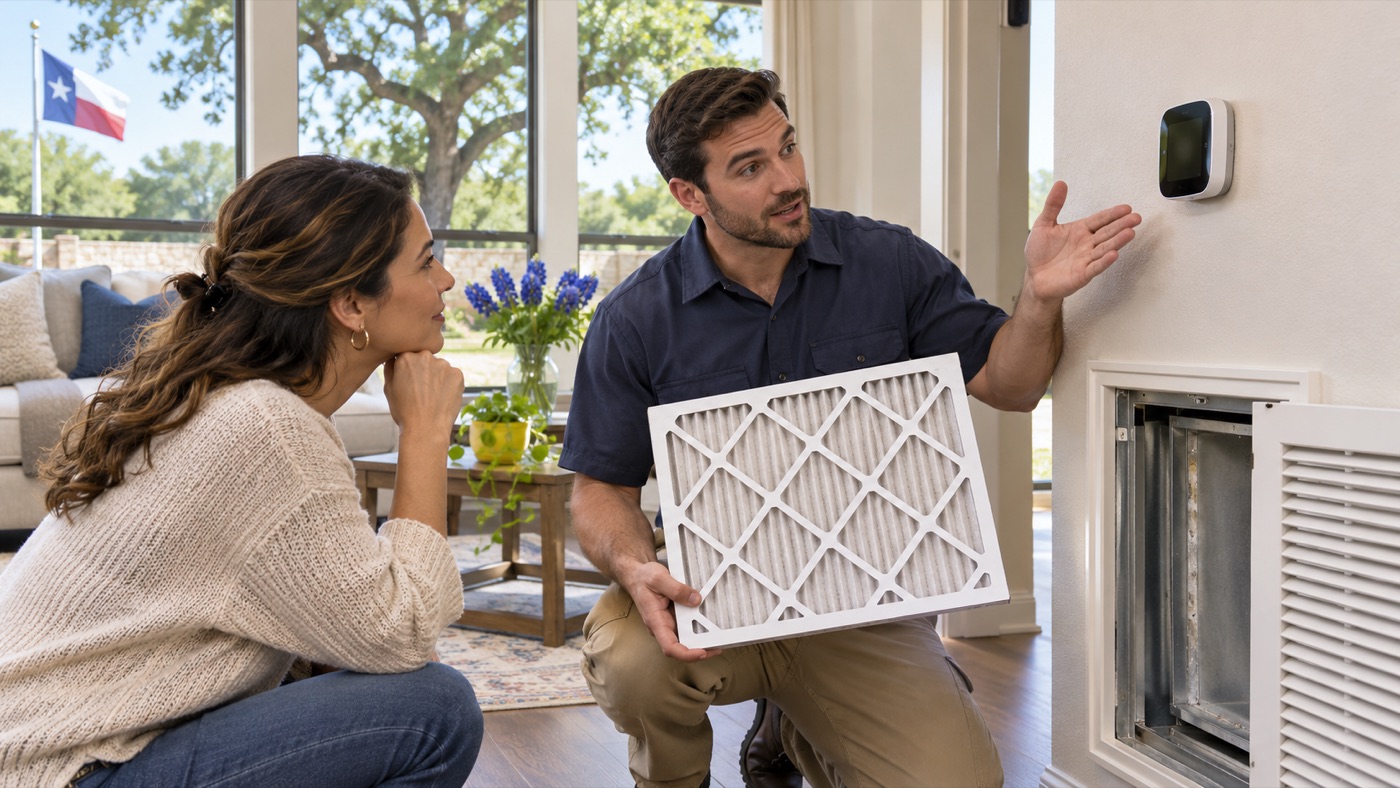
The filter’s main role is to protect equipment from dirt. Some filters also reduce particles in circulating air. How well a filter works depends on its rating, fit, condition, and how much air passes through it. If air bypasses the filter through a gap, the system can pull in particles without filtering them.
EPA says homeowners considering a more efficient HVAC filter can look for MERV 13 or the highest rating the system can accommodate. That final condition matters: a filter with more resistance than the system can handle can interfere with airflow. Ask the equipment manufacturer or a qualified HVAC professional before upgrading, especially if the filter slot is small or airflow is already weak.
Airflow can spread or reveal a problem
If return ducts are damaged or open in a dusty attic or wall cavity, the system may draw air from that space. Poorly sealed connections can also affect pressure and comfort. These conditions are not diagnosed by the filter label alone. A technician can inspect accessible return paths, filter fit, and equipment airflow.
Moisture can affect HVAC components
Air conditioners create condensation as they remove heat and moisture from indoor air. The condensate pan and drain need to work as intended. Standing water, a clogged drain, wet insulation, or condensation on ducts can point to moisture conditions that need attention. Moisture may support biological growth, but smell or appearance alone is not a reliable mold diagnosis.
Common indoor allergy-related sources to consider
| Possible source | Where it may come from | Useful first step |
|---|---|---|
| Pollen and outdoor particles | Doors, windows, pets, ventilation, or air leaks | Keep windows closed when outdoor conditions are irritating; clean entry areas |
| Pet dander and hair | Animals, bedding, upholstery, and rugs | Wash bedding and vacuum with an appropriate filter |
| Dust mites | Bedding and soft furnishings | Follow public health guidance for cleaning and moisture control |
| Mold-related moisture | Leaks, wet materials, condensation, or high humidity | Find and correct the moisture source; consult a qualified specialist when needed |
| Cleaning or cooking emissions | Products, smoke, and cooking | Reduce or ventilate at the source when safe and practical |
| HVAC filter bypass or dust | Poor fit, loaded filter, or return-side issue | Confirm filter size and inspect accessible system conditions |
The table is a starting point, not a diagnostic tool. Symptoms vary, and several sources may be present at once. If household members have significant or ongoing reactions, discuss them with a medical professional. The technician can help assess HVAC factors that may be contributing to the indoor environment.
What to check before scheduling service
- Filter condition and fit. Confirm the size, airflow direction, and replacement schedule. A filter should fit its slot without obvious gaps.
- Humidity and signs of water. A small hygrometer can help track indoor relative humidity. Look for visible condensation, water near the air handler, or a drain that overflows; avoid touching wet electrical equipment.
- When symptoms or odors occur. Note whether they happen in one room, after the system starts, during outdoor pollen periods, or after cleaning or cooking.
- Vent and return access. Keep grilles unblocked and wipe dust from accessible register covers. Do not put sprays or tools deep into the ductwork.
- Recent changes. New pets, renovations, carpet, cleaning products, water leaks, or open windows can change indoor conditions.
If an AC system is not cooling normally, has weak airflow, repeatedly shuts on and off, or leaves water near the indoor unit, arrange HVAC service. If you are concerned about visible mold on building materials or need sampling/remediation, ask a qualified mold or building specialist. ASC Heating & Air lists HVAC indoor-air-quality assessments and related services, but the company should not be represented as a medical provider or mold-remediation firm.
Keep a symptom and home-condition log
If reactions seem to happen in one room or during a specific activity, a simple log can help you explain the pattern to a clinician and, separately, to an HVAC technician. Write down the room, approximate time, whether the system was cooling, recent cleaning or cooking, windows or doors that were open, and any odor or visible moisture. Record the filter’s size and when it was last replaced. Avoid drawing conclusions from a single event; indoor and outdoor conditions change from day to day.
This record does not identify an allergy or prove the HVAC system is the cause. A clinician can evaluate symptoms and recommend medical testing or treatment. An HVAC professional can assess equipment operation, filter fit, airflow and moisture conditions that may affect the air in the home. Keeping these roles separate protects you from treating an equipment upgrade as a substitute for medical advice.
Ventilation and air cleaning have tradeoffs
Bringing in outdoor air can dilute some indoor contaminants when outdoor air is cleaner and the home has an appropriate ventilation path. On hot, humid, or high-pollen days, opening windows may also bring in heat, moisture, or outdoor particles. The right choice depends on local conditions and the home’s ventilation design; do not assume that more outdoor air always improves comfort.
Filtration is one part of indoor air management. EPA identifies source control and ventilation with clean outdoor air as important approaches, with filtration as a supplement. A portable cleaner can treat one room if it is appropriately sized and maintained. Central HVAC filtration treats air only as the system operates and circulates air through that filter. Neither option removes every pollutant, and filters require regular replacement.
Be cautious of devices sold with broad claims about killing every contaminant or improving health. Ask what the technology captures, what evidence applies to your intended use, and whether the device intentionally generates ozone. EPA advises against using ozone generators in occupied spaces. For a higher-rated central filter, check system compatibility first; a more restrictive filter may be unsuitable for some systems.
When a healthcare or building specialist is the right call
Seek medical guidance for persistent, severe, or concerning symptoms, especially if breathing is affected. If symptoms appear tied to a visible water problem, extensive mold-like growth, or damaged materials, a qualified building or mold professional may be needed to investigate the structure. The HVAC technician can inspect relevant equipment and ducts but should not diagnose a medical cause or claim to remediate all building mold.
When booking HVAC service, describe the observations rather than telling the company the home “has mold” or “has an allergy problem.” Say where the odor or dust appears, whether airflow changed, whether water is visible, and what filters have been used. Ask the technician what was inspected and how a recommendation connects to an observed condition. This makes the visit more focused and lets you compare proposed work clearly.
A note about filters during high-pollen periods
During seasonal pollen, a filter may load faster than usual, but changing it more often does not guarantee that all outdoor pollen is removed. Keep doors and windows closed when practical if outdoor air is aggravating symptoms, clean pollen from pets and entry areas, and follow the filter’s service instructions. If the system’s airflow drops or the filter appears dirty quickly, have the fit and condition checked rather than moving to a restrictive filter without confirming compatibility.
Choosing a filter, air cleaner, or other solution
HVAC filter
Use a correctly sized filter that fits the return opening and is approved for the equipment. An upgraded MERV rating may capture more particles, but compatibility and airflow matter. Change the filter as recommended and check it more often when conditions are dusty or the system runs heavily.
Portable air cleaner
A portable cleaner can be sized for one room and run where people spend time. EPA recommends considering the clean-air delivery rate (CADR) for the room, ongoing filter costs, and noise. A particle filter will not remove every gas or odor. Devices that intentionally generate ozone should not be used in occupied spaces.
Source control and moisture correction
Removing a pollutant source is often more direct than filtering it after it spreads. Keep moisture sources under control, repair leaks, vent moisture-producing activities when appropriate, and clean dust from surfaces. If the HVAC system has a condensate or airflow problem, correct that condition instead of adding a purifier as a substitute.
Whole-home humidity control
EPA advises keeping relative humidity below 60%, ideally between 30% and 50% when possible. A dehumidifier may be appropriate for some homes, but first consider whether the AC is operating correctly, the home has a water leak, or outdoor air is entering through a building issue. Equipment should be selected and installed for the house and system.
What an HVAC assessment can and cannot tell you
A service visit can review filter installation, airflow, accessible coils and drain components, duct condition, humidity concerns, and AC operation as relevant to the reported issue. Ask what was inspected and which observation supports each recommendation. A technician may identify an HVAC issue, but cannot determine whether a person has an allergy or promise that an air-cleaning product will resolve symptoms.
For an HVAC-related evaluation in San Antonio, explore ASC’s indoor-air-quality service, AC repair, or contact ASC Heating & Air. Share the symptom pattern, filter changes, humidity readings, and any visible water concerns.
Frequently asked questions
Can my AC cause allergy symptoms?
An HVAC system can move particles and moisture conditions can affect the indoor environment, but symptoms have many possible causes. An HVAC inspection can assess the equipment; a healthcare professional should evaluate health symptoms.
Can an air filter stop pollen and pet dander?
An appropriate filter may capture some particles that pass through it. It will not capture everything, and it cannot remove particles already settled on surfaces. Filter fit and system compatibility matter.
Is a higher MERV filter always better?
No. The filter must fit and allow the system to move air as designed. Consult the equipment instructions or an HVAC professional before moving to a more restrictive filter.
Does a musty smell prove that mold is in the AC?
No. Odor may have several causes. Have moisture and HVAC conditions inspected; mold identification or remediation may require another qualified specialist.
Will duct cleaning cure allergies?
No. EPA says duct cleaning has not been shown to prevent health problems and does not recommend routine cleaning. Consider cleaning only when specific visible conditions support it, and do not accept medical claims as proof.
What humidity level should I aim for?
EPA recommends keeping indoor relative humidity below 60%, ideally between 30% and 50% if possible. Use a hygrometer to measure rather than relying only on how the room feels.
Sources and next steps
Technical references: EPA’s Guide to Air Cleaners in the Home, EPA’s duct-cleaning guidance, and EPA’s indoor humidity guidance. Local San Antonio discussions informed the questions about indoor symptoms, musty odors, dust, and whether duct cleaning is worth paying for. Community comments are anecdotal, not medical or technical proof.
If the concern involves HVAC airflow, moisture, or filtration, contact ASC to discuss an appropriate assessment.

About the Author
Ron Carter | Founder, ASC Heating & Air
Ron Carter has more than 20 years of hands-on HVAC experience as a technician, instructor, sales manager, and business owner. He leads ASC Heating & Air, a family-owned company serving San Antonio. Ron is a licensed Air Conditioning and Refrigeration Contractor in Texas (License No. TACLB00031551E). His articles share practical guidance to help homeowners make informed decisions about heating, cooling, and preventive maintenance.