

Quick answer: An AC filter catches some airborne particles that pass through the return side of the system, but it does not remove every particle in a home or dust that has already settled. Dust can come from people, pets, cooking, fabrics, outdoor pollen, renovation work, a poorly fitting filter, or air leaks around return ducts. A dusty return grille alone does not prove the ducts need cleaning. Start with the filter and visible airflow path; ask for an inspection if debris blows from supply vents or dust keeps returning unusually fast.
Why dust can remain when the AC is running
Central air conditioning is designed mainly to move heat and remove some moisture. The filter protects equipment and captures a portion of particles carried through it. It is not a whole-house vacuum. Dust sitting on a table, fibers released from clothing, and particles stirred up by walking may not pass through the filter before settling again.
The system also filters air only when it is moving through the return and filter. If doors are open, people are active, or a fan is off, particles can remain in rooms. Outdoor pollen and soil can enter through doors, windows, pets, and normal air leakage. San Antonio homeowners may notice dust more during windy, dry periods or when pollen is high, but the source can still be indoors.
Common reasons a home gets dusty
Everyday household sources
Skin flakes, pet dander, lint, bedding, rugs, upholstered furniture, paper, and cooking all contribute to household particles. Cleaning, sweeping, and vacuuming can temporarily lift settled material into the air. If dust builds up on shelves and furniture throughout the home, the source may be ordinary household activity rather than the ductwork.
Filter fit, condition, and airflow
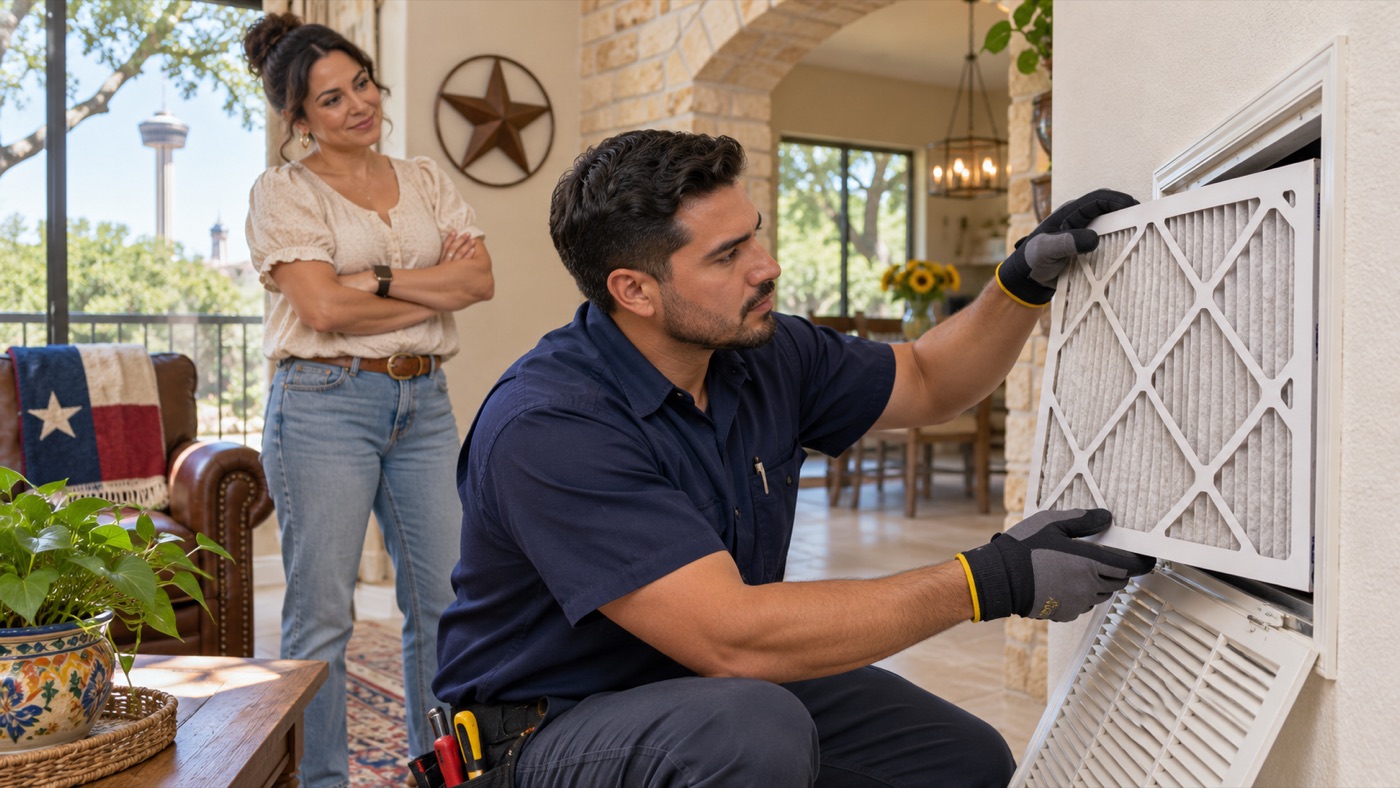
A filter that is overloaded can restrict airflow. A filter that is too small, installed backward, bowed, or not seated tightly may let some air bypass its edges. Check the size printed on the old filter and the airflow arrow before replacing it. Follow the equipment or filter instructions for service intervals; pets, construction, and heavy system use can change how quickly a filter loads.
Do not automatically choose the highest MERV rating available. A higher-efficiency filter can add resistance, and the system must be able to move air through it. EPA advises using a MERV 13 filter, or the highest rating the system can accommodate; the equipment manufacturer or HVAC professional can help confirm compatibility. A restrictive filter may worsen an existing airflow problem.
Leaky return ducts or gaps near the filter
The return side pulls air toward the equipment. If a return duct has an opening in an attic, garage, wall cavity, or other dusty space, it may draw in air from that area. A gap around a filter can also let unfiltered air pass. These issues need inspection because a homeowner may not be able to see the full return path.
Recent construction or remodeling
Drywall sanding, flooring work, insulation, and cabinet installation can release fine debris that settles across a home. Dust can reach registers when the system is operating during work or when ducts are left uncovered. After remodeling, clean surfaces and filters and have visible debris near registers or equipment assessed before paying for a whole-duct cleaning.
Ducts are only one possible source
EPA notes that dirt on a return grille is normal as air is pulled through it, and that dust in ducts does not necessarily enter living spaces. Routine duct cleaning is not a guaranteed fix for dust or allergies. Consider it when there is substantial visible mold on hard-surface ducts or HVAC components, vermin, excessive debris, or particles actually coming out of supply registers. Ask the provider to show the condition that supports the recommendation.
A simple way to narrow down the source
| What you notice | What it may suggest | Sensible next step |
|---|---|---|
| Light dust on return grille | Normal air movement through the grille | Vacuum or wipe the grille; monitor other rooms |
| Dust across shelves and furnishings | Household, outdoor, or cleaning sources | Check cleaning routine, pets, windows, and filter condition |
| Dust appears quickly after a remodel | Construction debris | Replace a loaded filter and inspect accessible registers |
| Visible debris blows from supply vents | Duct, filter bypass, or equipment issue | Photograph it and request an HVAC inspection |
| One room is dusty or has weak airflow | Local duct/register or room issue | Note the room and ask for airflow and duct checks |
The pattern matters. Note whether dust collects near one return, appears in multiple rooms, or blows from a supply vent when the system starts. Also note when the filter was changed and whether a renovation, new pet, or change in cleaning routine preceded the problem. That timeline helps a technician focus the inspection.
Safe checks you can make at home
- Look at the filter. Confirm it is the correct size, installed in the direction shown by its arrow, and not visibly clogged or damaged.
- Check the filter slot. If it leaves obvious gaps or the filter will not sit flat, tell the technician. Do not wedge loose material into the equipment.
- Keep returns and supplies clear. Furniture, drapes, rugs, and boxes can block airflow at grilles.
- Clean the grille, not the duct interior. Vacuuming a removable grille is a reasonable basic task. Avoid pushing tools deep into ductwork or spraying chemicals into vents.
- Track the dust pattern. A photo and a short note about when it returns can be more useful than guessing that every duct is dirty.
If dust is accompanied by weak airflow, unusual odors, water near the indoor unit, ice, or rooms that no longer cool well, the issue may involve equipment or duct performance. ASC Heating & Air provides indoor-air-quality assessments, AC repair, and duct-related services in San Antonio. Review the Indoor Air Quality & AC Repair page or request an appointment through ASC’s contact page.
How to tell whether the dust is coming from one room or the whole system
Dust patterns can help narrow the next step. If one room gets dusty while the rest of the home does not, consider room-specific sources first: a frequently opened exterior door, pet bedding, a rug, a nearby construction area, or a supply register with visible debris. If a single room also has weak airflow or is much warmer, describe both symptoms together. The issue may involve the room’s duct branch, a closed damper, a register boot, or the return path rather than every duct in the house.
If dust seems to settle throughout the home, think about whole-home conditions: recent remodeling, filter fit, a return-side leak, a new household activity, or outdoor particles entering through doors and windows. Change one low-risk factor at a time, such as replacing a visibly loaded filter with the correct type, so you can observe whether the pattern changes. If several things are changed at once, it becomes harder to tell what helped.
Keep a short record for a week. Note the rooms where dust returns, the date the filter was changed, whether the AC was running, and any unusual activities such as sanding, vacuuming, or leaving windows open. This is not a substitute for an inspection, but it gives the technician a useful starting point and helps avoid a broad, unsupported diagnosis.
Filter replacement and maintenance: what affects the schedule?
There is no single filter-change interval that works for every house. The filter label and system manual should be the starting point. A thin one-inch filter may need attention more often than a deeper media filter, but use the equipment guidance rather than assuming thickness alone determines the schedule. Homes with pets, construction dust, or longer cooling run times may load a filter sooner than a lightly occupied home.
Inspect the filter regularly during heavy AC use. If it is gray with debris, visibly clogged, damaged, or bowed inward, replace it according to the manufacturer’s instructions. If a new filter becomes dirty unusually quickly, look for a change in household dust or ask for an inspection of filter fit and return-side leakage. Do not run the system without a filter to “improve airflow”; unfiltered dirt can collect on equipment surfaces.
What if dust continues after changing the filter?
First confirm that the replacement is the correct size and that the arrow points in the direction of airflow. If the filter sits loosely, does not cover the opening, or slides out of place, the air may pass around it. Next, check whether vents are blowing visible particles or whether dust is simply settling on surfaces. Those are different clues. A technician can check the filter rack, return duct, accessible connections, blower and coil condition, and airflow where the symptoms point.
If the system checks out, investigate the home itself. Air sealing, entry mats, changing vacuum bags or filters, washing bedding, and keeping windows closed during dusty outdoor conditions may reduce particles entering or remaining indoors. Such steps are not guaranteed to solve every case; they help identify the source before investing in duct cleaning or an air-cleaning device.
Choosing a filter or air cleaner
The right filter depends on the particle concern and the HVAC system. A filter is labeled with a size and a MERV rating. MERV describes how effectively it captures particles in a test; it does not tell you whether that filter will fit your equipment or how often it needs replacement. Check the system manual, filter-slot dimensions, and airflow needs first.
A portable air cleaner can be a practical option for one room if it is sized for that room and maintained. EPA says filtration can supplement source control and ventilation, but no filter or cleaner removes every pollutant. Avoid ozone generators in occupied spaces. If you are considering an in-duct air-cleaning product, ask what it is intended to address, how it is maintained, and whether it is compatible with your system.
When to call an HVAC professional
Arrange an inspection if dust is visibly blowing from supply registers, the filter repeatedly collapses or loads quickly, airflow has dropped, the home is dusty after a filter change despite ordinary cleaning, or the issue follows a duct repair or remodel. Ask the technician to inspect filter fit, return leaks, airflow, accessible ducts, and equipment condition before recommending a service.
You can ask: “What did you see that makes cleaning necessary?” “Can you show me the debris or opening?” “Is the filter right for this system?” “Could the dust be coming from an indoor source?” An evidence-based recommendation should explain the observed condition and the work proposed. Avoid paying for a treatment based only on a dusty grille or a claim that cleaning will cure health symptoms.
Frequently asked questions
Why is my house dusty even with the AC running?
The AC filter only captures particles that pass through the return and filter. Household activity, pets, fabrics, outdoor particles, filter gaps, return leaks, and construction can all add dust. Dust is not automatically evidence of dirty ducts.
Does a dusty return vent mean my air ducts need cleaning?
No. EPA says some dust on a return grille is normal. A visible dust layer on the grille alone does not show that the duct interior has excessive debris.
Will a higher-MERV filter stop dust?
It may capture more of some particles if the system supports it, but it cannot stop all dust or remove settled particles. Confirm the filter’s size and airflow compatibility before upgrading.
Should I have the ducts cleaned after remodeling?
Not automatically. Replace a loaded filter, clean surfaces, and look for visible construction debris. If debris is inside the system or coming from supply registers, request an inspection and ask for evidence before approving cleaning.
Can duct cleaning help allergies?
Duct cleaning has not been shown to prevent health problems. Allergies have many possible causes; discuss persistent symptoms with a healthcare professional. HVAC filtration may address some airborne particles but is not a medical treatment.
How often should I change the AC filter?
Use the interval on the filter or equipment instructions and check it more often during heavy use or dusty conditions. Replace it when loaded or as directed; a single schedule does not fit every home.
Sources and related help
Technical guidance: EPA duct-cleaning guidance and EPA’s guide to home air cleaners and HVAC filters. Local San Antonio discussions were reviewed to understand homeowners’ concerns about recurring dust, allergies, duct-cleaning value, and upselling; those comments are individual anecdotes, not proof of technical causes.
For a system-specific assessment, explore indoor air quality services in San Antonio or call ASC Heating & Air at (210) 761-5130.

About the Author
Ron Carter | Founder, ASC Heating & Air
Ron Carter has more than 20 years of hands-on HVAC experience as a technician, instructor, sales manager, and business owner. He leads ASC Heating & Air, a family-owned company serving San Antonio. Ron is a licensed Air Conditioning and Refrigeration Contractor in Texas (License No. TACLB00031551E). His articles share practical guidance to help homeowners make informed decisions about heating, cooling, and preventive maintenance.