

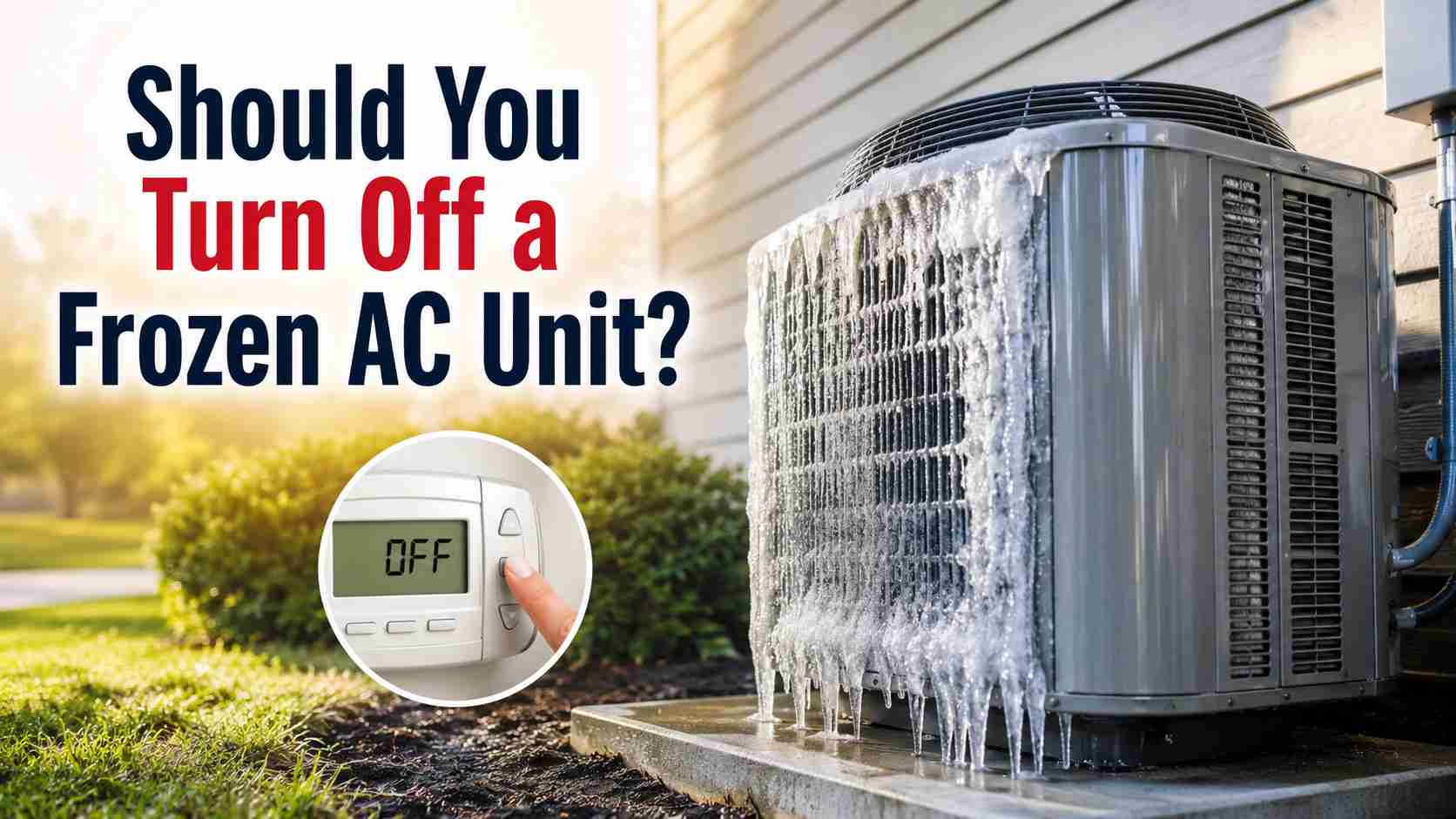
Quick answer: Yes, you should turn off a frozen AC unit. Switch the thermostat from cool to off so the compressor stops running. You may run the fan only if it is safe and the system is not leaking near electrical parts. Do not chip away ice. If the AC freezes again, leaks water, blows warm air, or stops cooling during San Antonio heat, call for 24/7 emergency AC repair in San Antonio.
2. Warning Signs
3. What To Do
4. FAQs
Frozen AC Action Guide
Yes, Turn the Cooling Mode Off
If your AC is frozen, the first step is to turn cooling mode off. Do not keep lowering the thermostat. Do not wait for the ice to “work itself out” while the compressor keeps running.
In our experience, running a frozen AC is one of the easiest ways to make the problem worse. The system is already struggling to absorb heat. Keeping it on can increase stress on the compressor and may lead to more water once the ice melts.
A frozen AC usually means something interrupted airflow, refrigerant movement, or heat transfer. The ice is the symptom. The cause still needs attention.
That is especially true in San Antonio, where cooling systems work hard for long stretches. A frozen system in summer can leave the home uncomfortable quickly.
Turn Cooling Off
Set the thermostat to off so the compressor stops running while the system thaws.
Do Not Break the Ice
Chipping or scraping ice can damage coils, lines, insulation, or nearby parts.
Check the Filter
A clogged filter is one of the simplest airflow problems to spot.
Call if It Freezes Again
A repeat freeze usually means the underlying problem has not been fixed.
What a Frozen AC Looks Like
A frozen AC is not always obvious at first. You may only notice that the air feels weak, warm, or humid.
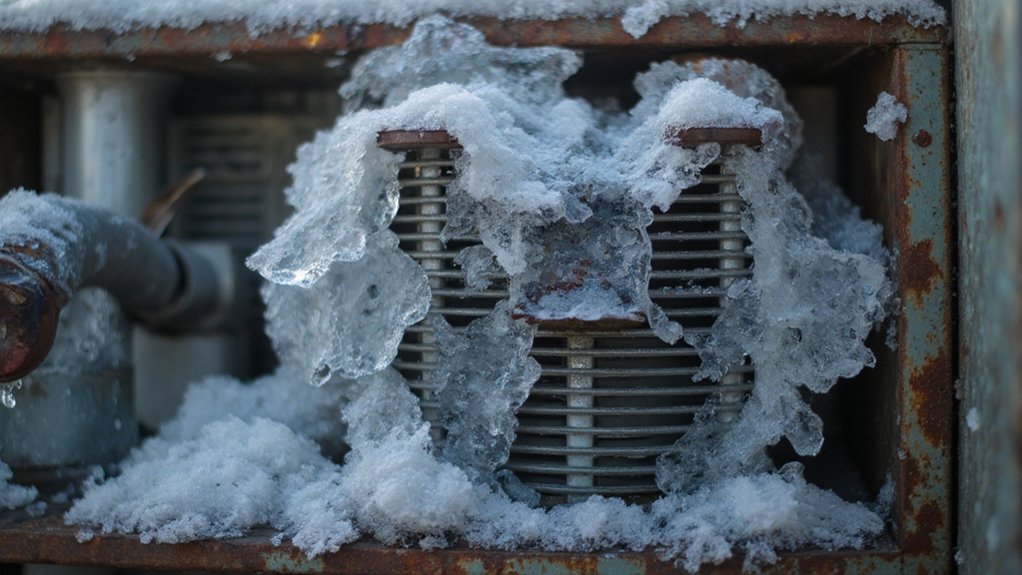
Then you may see frost or ice on the copper refrigerant line near the indoor unit or outdoor unit. In some cases, the indoor evaporator coil is covered in ice, but you cannot see it without opening the cabinet.
Many customers first notice water. After the ice melts, water may drip around the indoor unit, stain a ceiling, fill a drain pan, or collect near the air handler.
Common signs include:
- Ice on the refrigerant line
- Weak airflow from vents
- Warm or room-temperature air
- AC running for a long time without cooling
- Water around the indoor unit
- Humidity staying high indoors
- A thermostat that never reaches the set temperature
If you see these signs together, treat the system as frozen until proven otherwise.
Why AC Units Freeze in Hot Weather
Many homeowners are surprised by this question: how can an AC freeze when it is hot outside?
The answer is that freezing is not about outdoor temperature. It is about what is happening inside the cooling system.
An air conditioner removes heat from indoor air. Wikipedia’s overview of air conditioning explains that AC systems condition indoor air by controlling temperature and humidity. If the system cannot absorb enough heat across the indoor coil, the coil can get too cold and freeze moisture from the air.
What we commonly find is that frozen AC calls involve one of three categories: not enough airflow, refrigerant-related problems, or a dirty coil.
Those problems can overlap. A dirty filter can reduce airflow. Reduced airflow can freeze the coil. A frozen coil can create water. The water can make the homeowner think the drain is the main issue, even though the freeze started the chain.
Common Cause 1: A Dirty Air Filter
A dirty filter is one of the easiest things to check. If the filter is packed with dust and debris, the system cannot move enough air across the evaporator coil.
When airflow drops, the coil temperature can fall too low. Moisture freezes on the coil, and the freeze can spread.
Based on real-world experience, this often happens after the filter has gone longer than expected during heavy cooling season. Homes with pets, dust, remodeling work, or high AC runtime may need more frequent filter changes.
Pull the filter out and look at it. If it is gray, bent, damp, clogged, or hard to see through, replace it.
Pro tip: Replacing the filter is helpful, but it does not instantly thaw the coil. Keep cooling mode off until the ice is gone. If freezing returns, the filter was not the only issue.
Common Cause 2: Low Airflow From the Blower or Ducts
The filter is not the only airflow source. A weak blower motor, dirty blower wheel, closed vents, blocked returns, crushed ducts, or dirty evaporator coil can also reduce airflow.
One thing we commonly find is that homeowners close vents in unused rooms to try to save energy. That can change system airflow and pressure. It may make comfort worse instead of better.
If several vents have weak airflow, the problem may be more than a dirty filter. The technician may need to inspect the blower, coil, return air path, and duct condition.
Energy.gov notes that air conditioner maintenance includes attention to filters and coils. Clean airflow paths matter because the system cannot cool properly if air cannot move through it.
Common Cause 3: Refrigerant Problems
A refrigerant issue can also cause freezing. If the system is low on refrigerant because of a leak, pressure and coil temperature can change in a way that causes ice.
Many customers ask if the system just needs to be “topped off.” In our opinion, that is the wrong way to think about it. Refrigerant should not disappear under normal operation.
If the system is low, the bigger question is why. A technician may need to locate a leak, evaluate repair options, and decide whether charging the system makes sense based on age, condition, and refrigerant type.
Do not try to handle refrigerant yourself. It requires proper tools, training, and legal handling requirements.
Common Cause 4: Dirty Evaporator Coil
The evaporator coil is where indoor heat is absorbed. If that coil is coated with dirt, dust, or buildup, air and heat transfer are both affected.
A dirty coil can make the system run longer, cool poorly, freeze, and use more energy. It can also lead to water problems once ice melts.
What we have seen on neglected systems is that a dirty filter and dirty coil often show up together. The filter may have allowed debris past it, or the system may have run with no filter at some point.
Coil cleaning is not the same as wiping a vent cover. The coil is delicate and should be cleaned properly to avoid damage.
What To Do While the AC Thaws
Once you turn cooling off, the ice needs time to melt. The thawing time depends on how much ice is present, indoor temperature, airflow, and humidity.
Use towels if water is dripping in a safe area. Keep an eye on ceilings, floors, and the drain pan if the unit is in an attic or closet.
You may be able to set the fan to on to move room-temperature air across the coil, but do not do this if water is leaking near electrical components or if you are unsure the system is safe.
Do not use sharp tools, heat guns, open flame, boiling water, or force. Those can damage the equipment or create safety risks.
Important note: If water is leaking through a ceiling, near wiring, or around finished areas, turn the system off and call for help. The water damage risk can become urgent.
Frozen AC Do and Do Not Table
| Action | Do It? | Why It Matters |
|---|---|---|
| Turn cooling mode off | Yes | Stops the compressor from running while the system is frozen |
| Check and replace a dirty filter | Yes | Restores one possible airflow restriction |
| Run fan-only mode | Maybe | Can help thaw the coil if there is no unsafe leaking or electrical concern |
| Chip ice off the coil or line | No | Can damage coil fins, lines, insulation, or nearby parts |
| Restart cooling before all ice is gone | No | The system may freeze again quickly and stay under stress |
| Ignore repeat freezing | No | Repeat freezing usually means an underlying problem remains |
When a Frozen AC Becomes an Emergency
A frozen AC should be handled soon, but it is more urgent in certain situations.
Call for emergency service if the AC is frozen during extreme heat, the home is getting unsafe, someone in the home is heat-sensitive, water is leaking through the ceiling, the breaker trips, or you smell burning.
A frozen system paired with warm air is also a strong sign that the AC is not doing its job. Read the related guide Why Your AC Is Blowing Warm Air for more troubleshooting context.
The guide 5 Signs Your AC Needs Emergency Repair can also help you decide whether the issue should be handled immediately.
Frozen AC in San Antonio?
If your system freezes, leaks, or stops cooling during hot weather, ASC Heating & Air can help diagnose the cause. Start here: 24/7 emergency AC repair in San Antonio.
What a Technician Will Usually Check
A frozen AC diagnosis should look beyond the ice. The technician needs to understand why the freeze happened.
On an actual project, that may include checking the filter, return airflow, blower operation, evaporator coil condition, drain pan, refrigerant line, outdoor unit, temperature split, and refrigerant readings.
What customers commonly ask is whether the system can simply be restarted after it thaws. Sometimes it can run again for testing, but the cause still matters.
If the system freezes again after a filter change, that is a sign to stop guessing and schedule a professional diagnosis.
How To Prevent Future Freezing
Not every frozen AC can be prevented, but many can be reduced with basic care.
- Change filters on a schedule that matches your home and system use.
- Keep returns open and unblocked.
- Avoid closing too many supply vents.
- Keep the outdoor unit clear of weeds and debris.
- Schedule regular AC maintenance before peak heat.
- Call early if airflow gets weak or cooling drops.
In our experience, weak airflow is often the early warning. If you catch that symptom before the coil freezes, the repair may be simpler.
Frequently Asked Questions
Should I turn off my AC if the line is frozen?
Yes. Turn cooling mode off if the refrigerant line is frozen. Let the system thaw and call for service if the ice returns or the system does not cool normally.
Can I run the fan while the AC is frozen?
You may be able to run fan-only mode to help thaw the coil, but do not do this if water is leaking near electrical parts or if the system seems unsafe.
How long does a frozen AC take to thaw?
Thawing can take several hours depending on how much ice is present. Do not restart cooling until the ice is gone.
Will changing the filter fix a frozen AC?
Changing a dirty filter can help if airflow was the cause, but it does not fix every frozen AC. If freezing returns, another issue is likely present.
Is a frozen AC dangerous?
The ice itself is not usually dangerous, but the situation can become urgent if water leaks, electrical issues appear, the breaker trips, or the home gets too hot.
Final Takeaway
Yes, you should turn off a frozen AC unit. Stop cooling mode, let the system thaw, check the filter, and avoid forcing the AC to run while ice is present.
If this were our own home, we would treat repeat freezing as a real warning sign. Ice means the system is not moving heat correctly, and the cause should be found before the equipment is pushed through another hot day.

Owner, ASC Heating & Air
Ron Carter is the owner of ASC Heating & Air, a family-owned HVAC company serving San Antonio and the surrounding communities. With more than 20 years of hands-on HVAC experience, Ron has built his reputation on honest recommendations, quality workmanship, and dependable customer service.
He specializes in residential heating and air conditioning repair, installation, replacement, and preventative maintenance, helping homeowners make informed decisions that improve comfort, efficiency, and the lifespan of their HVAC systems. Through his articles, Ron shares practical insights gained from years in the field, answering common homeowner questions and providing trusted advice tailored to the unique heating and cooling challenges of South Texas.